
Office Move Checklist & Project Plan: The Complete UK Guide
UK office move checklist: start planning 6 months out, appoint one move manager by month 5, order new-site connectivity and book lift access by month 3, and complete waste transfer notes, the fire risk assessment review, and DSE workstation assessments before and immediately after day one.

Fast-scan summary
- Six months out: appoint one internal move manager with real authority, confirm the lease exit position, and instruct a dilapidations assessment before signing anything new.
- Three months out: order connectivity for the new site (new installs can take months, longer where wayleave consent is needed), book lifts and loading bays at both buildings, and start the asset audit.
- One month out: freeze new purchases, issue desk allocations, complete crate distribution, and confirm waste carriers hold current Environment Agency registration.
- Move weekend: sequence IT decommission last-out, first-in; keep a live issues log; sign off room by room.
- Week one after: complete DSE workstation assessments, review the fire risk assessment, and file every waste transfer note for the two-year statutory retention period.
A downloadable Excel version of the full checklist, with owner, deadline, and status columns pre-built across every phase, is available to download here. No form, no email address required.
Why Do Most Office Relocations Overrun?
New-site internet is the most common single point of failure. A new leased line or fibre-to-the-premises install involves a survey, possible wayleave agreements with the landlord, and civil works if ducting is missing. Wayleave negotiation adds weeks or months wherever a freeholder is slow to respond. A business that orders connectivity late and then hits a wayleave delay moves into an office with no internet.
The second failure mode is physical access. Multi-tenant buildings in Manchester, Leeds, Birmingham, and the City of London commonly require goods lifts and loading bays to be booked through building management, sometimes weeks ahead, and many restrict moves to evenings and weekends. A crew arriving at 8am on a Saturday to find the goods lift reserved by another tenant loses the entire day. Book access at both buildings the same week the move date is fixed.
The third is the old office. Handing back a leased floor is not “lock the door and post the keys”. Dilapidations, cabling removal, and furniture clearance all carry cost and lead time, and the departing tenant remains legally responsible for every item and every kilogram of waste that leaves the building. Structured office clearance and decommissioning planned alongside the move, rather than after it, is what keeps the exit date and the deposit intact.
What Does the Six-Month Countdown Look Like?

| Phase | Timing | Non-negotiable actions | Gate to pass |
|---|---|---|---|
| Strategy | Months 6 to 5 | Appoint move manager; confirm lease break/expiry and notice mechanics; instruct dilapidations assessment; set headline budget; brief the board | Signed move mandate with budget and dates |
| Procurement & design | Months 4 to 3 | Order new-site connectivity; tender relocation partner; agree space plan and desk numbers; book lifts/loading bays both ends; audit assets and tag disposals | Contracts signed; connectivity order confirmed in writing |
| Preparation | Months 2 to 1 | Purchase freeze; crate delivery and packing schedule; change-of-address programme; staff comms and desk allocations; confirm waste carrier licences | Every asset has a destination: new office, storage, reuse, or licensed disposal |
| Move window | Day(s) 0 | IT decommission last-out, first-in; marshals at both sites; live issues log; room-by-room sign-off | Signed completion checklist, both buildings |
| Stabilisation | Weeks 1 to 4 after | DSE assessments; fire risk assessment review; snagging list closed; waste transfer notes filed; old-site handback and dilapidations settlement | Statutory paperwork complete and archived |
The single most useful discipline in the whole plan: every line in the checklist gets one named owner and one date. “IT” is not an owner. “Soon” is not a date.
Which Legal Deadlines Catch UK Businesses Out?

Waste duty of care. Section 34 of the Environmental Protection Act 1990 makes the business producing the waste responsible for it until lawful final disposal. Every skip, every clearance load, and every pallet of scrapped furniture needs a waste transfer note, transferred only to a carrier registered with the Environment Agency, and the notes must be retained for two years. Fly-tipped waste traced back to a company via an unlicensed “man with a van” clearance lands the fine on the company, not the van.
WEEE. Redundant IT and electrical equipment falls under the Waste Electrical and Electronic Equipment Regulations 2013 and cannot go in general waste. Hazardous items such as fluorescent tubes require consignment notes rather than standard transfer notes, retained for three years. Routing redundant kit through a documented IT asset disposal and sustainable decommissioning process closes both the environmental and the data-security exposure in one step.
Fire safety. Under the Regulatory Reform (Fire Safety) Order 2005, the responsible person must ensure a suitable fire risk assessment is in place for the premises the business occupies. Moving in is a material change: the assessment must be reviewed or redone for the new space, escape routes communicated, and fire marshals reappointed before full occupation, not at some point afterwards.
Display screen equipment. The Health and Safety (Display Screen Equipment) Regulations 1992 require workstation assessments for screen users. New desks, new monitor arms, and new chairs at the new site mean the previous assessments no longer describe reality. Schedule DSE reassessment into week one after the move.
Company registrations. The registered office address changes via Companies House form AD01, effective on registration. HMRC, the ICO register entry, business insurance policies, and the bank all need the new address separately; none of them update automatically.
Where Does the Money Actually Go in an Office Relocation?
| Cost line | What drives it | Why it gets missed |
|---|---|---|
| Dilapidations settlement | Lease terms, floor area, condition against the schedule | Falls due at lease end, months after the move budget closed |
| New connectivity install | Survey outcome, wayleave, civil works, contract term | Ordered late, expedite fees added |
| Cabling and containment removal at old site | Most leases require removal of tenant cabling on exit | Assumed to be the landlord problem; it is not |
| Furniture disposal or clearance | Volume, transport, and licensed disposal gate fees | Assumed to be free; landfill and transport are not |
| Business post redirection | Royal Mail business tariff, duration chosen | Small line, but a year of it protects invoices and cheques |
| Out-of-hours premium | Buildings that only permit evening or weekend moves | Only surfaces once building rules are read |
The cheapest lever in the whole budget is subtraction. Every cabinet, desk, and pallet that does not travel is money saved twice: once on transport, once on space at the destination. An asset audit in month 4 that tags a meaningful share of contents as “do not move” routinely outperforms any negotiation on the removal quote itself.
What Published Cost Guides Leave Out
This section is an observation about the checklist and cost-guide genre rather than a set of figures. Reading across the UK office relocation cost guides currently ranking on Google, two structural gaps recur.
First, per-desk figures are quoted without separating crate-and-carry costs from IT disconnection and reconnection, which is where most of the real variance between two quotes for the same office lives. Two quotes that look far apart are often pricing different scopes, not different efficiency.
Second, compliance costs are absent. Waste transfer notes, WEEE consignment, cabling removal, and dilapidations appear in almost none of the published cost breakdowns, despite being unavoidable spend for any leased office. A budget built from a typical online cost guide is therefore a budget for the visible half of the move.
The practical fix for both gaps: instruct quotes against a written scope that names the IT cutover, the clearance, and the compliance paperwork as explicit line items, so every bidder prices the same move.
Single-Weekend Move or Phased Relocation: Which Fits the Business?
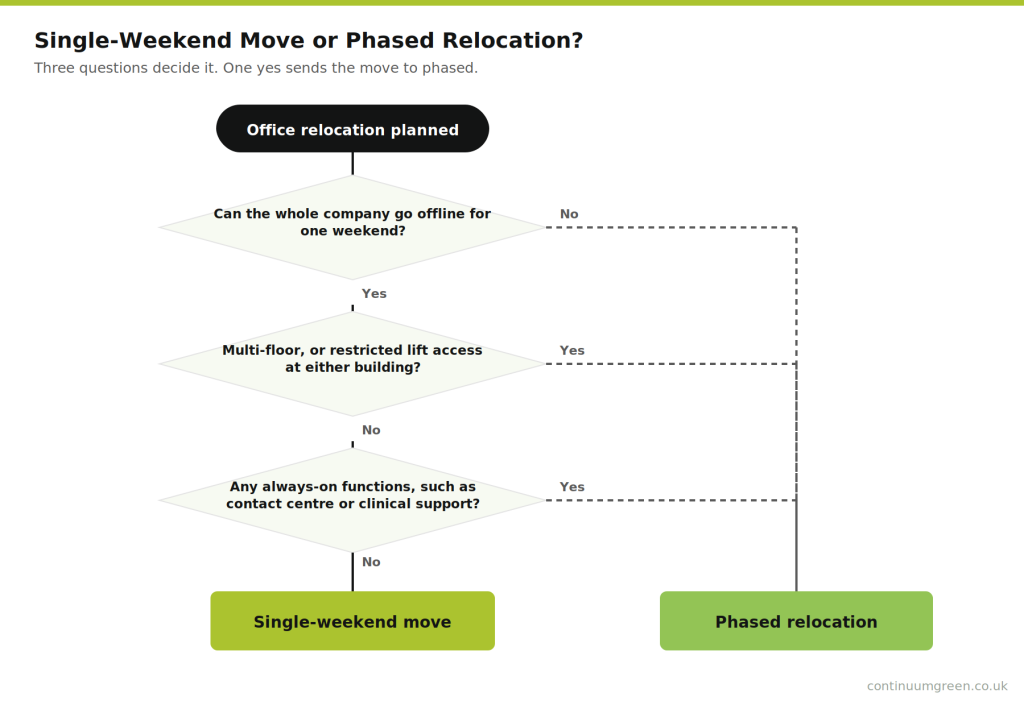
| Factor | Single weekend | Phased (2 to 4 weekends) | Why it matters |
|---|---|---|---|
| Best for | Smaller offices, one floor each end | Larger headcounts, multi-floor, regulated sectors | Lift capacity and crew size stop scaling cleanly with headcount |
| Downtime | Whole company offline for the window | Only the moving cohort offline each phase | Contact centres and clinical support functions often cannot go dark at all |
| Cost profile | Lower total, higher out-of-hours premium | Higher total, spread across phases | Each phase re-incurs crew mobilisation and lift bookings |
| IT risk | One big cutover, one rollback plan | Parallel running of two sites for weeks | Parallel running needs temporary connectivity at both ends |
| Main tradeoff | A failed weekend fails everything | Team fragmentation between sites | Choose the risk that the business can actually absorb |
The honest contrast: a small agency move done in one weekend is usually the cheaper option, but a large professional services firm attempting a single weekend needs thousands of crate movements to go right inside one window. Above a certain scale, the premium for phasing is an insurance payment, and a sensible one. Detailed sequencing of exactly this decision is the core of professional move planning and relocation project management.
How Should the IT Cutover Be Sequenced?

Three dates anchor the IT workstream:
- Circuit delivery at the new site. Order in the procurement phase at the latest. Test the line under load before move week, not on it.
- The legacy line question. Analogue phone lines and ISDN circuits are being withdrawn across the UK network as part of the national switch to digital voice services. Any business still carrying legacy lines should treat the move as the migration moment rather than paying to relocate technology that is being turned off. Check the current switch-off timetable with the provider when planning the cutover.
- Cease dates for old services. Diarise them after the stabilisation week, never inside the move window.
Server racks, comms cabinets, and desktop estates each need their own labelled shutdown and restart order, a photographed cabling record before disconnection, and asset-level tracking in transit. That workstream is a discipline of its own, covered in depth on the IT relocation service page, including how patching records and switch configurations survive the journey.
One operational detail that saves an hour of confusion per incident: every crate and every device carries a two-part label, destination room code plus sequence number, written to match the new floorplan room codes exactly. Crews deliver to codes, not to descriptions like “marketing corner”.
What Belongs on the Change-of-Address Programme?
Group the notifications and assign one owner per group:
- Statutory and financial: Companies House (form AD01), HMRC, the ICO register, business bank, business insurance (buildings, contents, and employers’ liability all re-underwrite on address), pension provider, payroll bureau.
- Property and rates: the billing authority for business rates at both old and new premises, utilities (final reads booked for move day), landlord and managing agent at both ends.
- Operational: every supplier with a standing delivery, every client with a billing address on file, card machine and merchant services providers, website, invoice templates, email signatures, and the Google Business Profile listing.
- Continuity: Royal Mail business redirection for a full year, activated from the first working day at the new site, as the safety net for everything the list above missed.
A shared tracker with columns for organisation, owner, date notified, and confirmation received turns this from a fortnight of anxiety into an afternoon of admin per week across month 2. The downloadable workbook below includes this tracker pre-built.
When Is This Checklist the Wrong Tool?
A checklist built for leased office relocations does not fit every situation, and pretending otherwise wastes reader time.
- Moves that are really fit-outs. Where the project is dominated by construction, partitioning, or mechanical and electrical works, the fit-out contractor programme leads and the relocation slots into it, not the reverse. This guide does not cover fit-out.
- Home-based businesses taking a first office. Most of the compliance load above (dilapidations, phased cutover, crate logistics) does not apply to a five-person team moving into a serviced office, where the licence agreement bundles connectivity and furniture. The genuinely useful parts of this page for that reader are the change-of-address programme and the DSE section; the rest can be skipped.
- Relocations involving heavy plant or industrial machinery. Machinery moving is a separate engineering discipline with its own insurance, lifting plans, and specialist contractors, and sits outside the scope of this plan.
- Businesses hoping a relocation will fix a culture or process problem. A move changes the postcode, not the operating model. Where the driver is dysfunction rather than space, the honest advice is to fix the process first; relocating a broken workflow produces the same workflow in a nicer room, minus a serious budget.
Office Move Checklist FAQ
How far in advance should an office move be planned?
Six months for a conventional leased office; nine to twelve months where a fit-out, a data centre element, or a regulated environment is involved. The constraint is rarely the physical move itself but the lead times feeding it: connectivity installs, lease notice periods, and furniture procurement all run on quarters, not weeks.
Who should manage an office relocation internally?
One named person with genuine decision authority and protected time, typically an operations or facilities lead, backed by a small move committee (IT, HR, finance, and a senior sponsor). The pattern that fails is distributing the move across departments with no single owner: fifteen part-owners and no accountable one.
What paperwork must be kept after the move?
Waste transfer notes (two years, statutory), hazardous waste consignment notes (three years, statutory), the reviewed fire risk assessment, DSE assessment records, the signed inventory and condition report for the old premises, and the dilapidations settlement correspondence. A single move archive folder created on day one makes the eventual lease-end and audit conversations short.
Can furniture from the old office be reused instead of dumped?
Usually, and the economics increasingly favour it. Desks, task chairs, and storage in serviceable condition can be redeployed to the new site, redistributed within a group, or passed into reuse channels rather than paying gate fees for disposal. Reuse also shortens the waste duty of care chain: an asset that finds a second life never becomes waste at all. Where reuse is not possible, disposal must still run through licensed carriers with transfer notes.
Is moving offices a reason to renegotiate supplier contracts?
Yes, and the window is real. Connectivity, printing, cleaning, confidential shredding, plants, and coffee all price differently at a new address, and incumbent suppliers expect the conversation. The move is the one natural moment where switching cost is already sunk; a supplier review in month 4 routinely funds a meaningful slice of the relocation budget.
The Downloadable Project Plan
The full checklist above is available as a formatted Excel workbook, free to download with no form and no email address: one tab per phase with owner, deadline, status dropdown, and evidence columns, plus the change-of-address tracker and the statutory waste paperwork log pre-built, and a progress summary that updates as tasks complete.
Download the Office Move Checklist & Project Plan (.xlsx)
For relocations where the internal team wants the plan executed rather than just downloaded, Continuum Green manages the full lifecycle described on this page, from office relocation planning through to clearance and handback of the old premises. The starting point is a conversation about dates, floors, and constraints, and the earlier that conversation happens in the six-month countdown, the more options stay open.